
Legmcmuffin

83

4

2

Hideriyama Suita

A full size Suita stone without the presence of Su. The pink pattern is called "renge." It resembles lotus blossoms. The brown is called "suji." Suji refers to non toxic inclusions. Toxic inclusions would be called "kesuji."

Back side sealed in cashew lacquer. This adds strength to the stone and repels water.

When wet, the renge pattern really shows.

Ozaki Tomae

This is considered a bench size stone. 8x3x1.25

Originally had full stamps, but I lapped them off. The chiseled back is from kawa removal. Kawa is the hard "skin" usually associated with jnats. It is believed that chiseled back stones are highest quality, and to some degree, that is true. It was done to "clean up" the stone and make it more presentable. It also allowed for a more accurate weight.

Lighting doesn't justify the coloration. Probably my prettiest stone. It's a mix of purple, pink, and green with dark purple streaks.

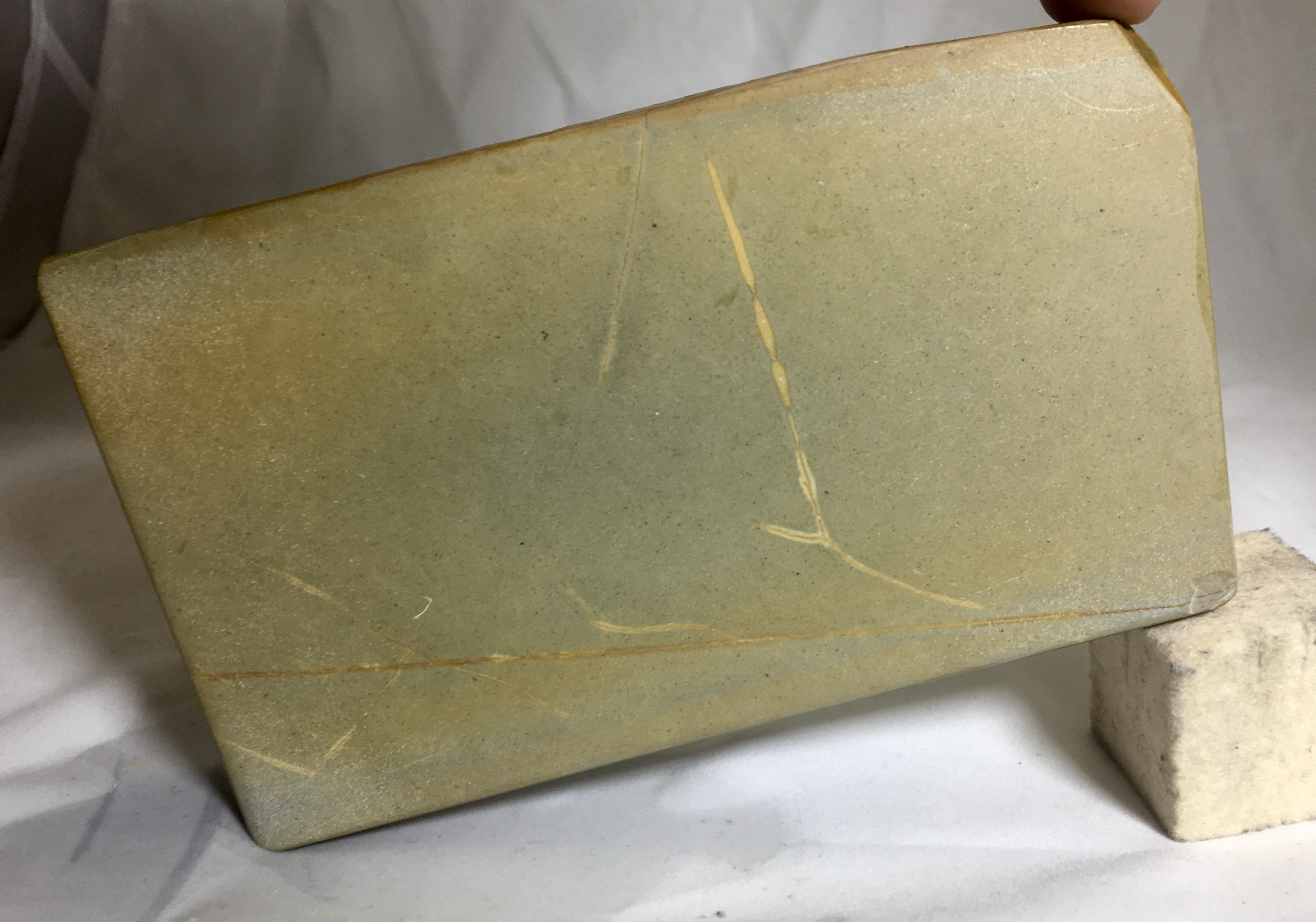
Unknown (believe it to be an ohira)

Unique coloration of blue/grey and brown. It also has some brownish colored renge-like patterns.

Label is pretty rough, but adds a certain quality. Unfortunately it doesn't mention the mine or layer.

Yake pattern is the yellow flakes

Ohira Sunashi Suita

Another full sized Suita. This stone is exceptionally hard for a Suita. This is probably my most rare stone.

It has the original box and came stamped, but i will never sell this stone, so I lapped it off.
Nakayama asagi

Another very old stone. Very high quality. Super dense and hard, very fast and very fine. Everything nakayama stones are famous for.

This is hand written as opposed to being stamped. It's unfortunately too broken up to be translated accurately.

Amazing coloration

Okudo Sunashi suita

Very thick and extremely fast. Perfect for midrange razor work or knife finishing. Sunashi means "without holes." "Su" is a word for holes. Suita typically have holes, so Sunashi stones are prized.

Beautiful kiita coloring with some green. Kiita can mean multiple things, but generally refers to the color yellow.

Okudo Sunashi Suita

This is the hardest and most glassy Suita I have handled. It's very rare to find a Suita of this hardness.

This is possibly the finest stone I have in terms of particle size. The hardness and fineness are unparalleled.

Nakayama asagi iromono koppa

Karasu back. Much softer than the top, which is insanely hard. Karasu is a pattern than means "crows," and sometimes looks like flying crows in a sky. Fairly rare and expensive. Koppa means "odd shaped."

When wet, the rainbow colors show.

Nakayama ocher

It is double sided, and is the oldest stone I have. It has a handmade wooden base, and was used with oil, so only one side can be used with water successfully.

I got this from an antique seller

I have not seen another stone with a surface pattern like this. Fairly unique. Fantastic finisher.
Geoffreynocon
Is the hideriyama still for sale saw it on ebay but unfortunately the post has ended. Im interested in buying it
EvilKam
Mikehippop
Natural sharpening stones? A rare and pleasant sight these days.
Legmcmuffin
Thank you!
CharlieNoOne
Supper cool post! How much would one of these things run?
Legmcmuffin
It depends on a plethora of variables. I have seen stones go for $10,000+
gavman1066
But what is it for?
Legmcmuffin
Sharpening knives and razors
gavman1066
Aaaaaah now it makes sense