
smax410

1722

31

4

Finished product first, as was the custom at the time. This is the first brisket I turned out that I am happy with, and I am really happy with it.

Trimmed and seasoned. Kosher salt, lowrys, cayenne, smoked paprika, garlic powder, granulated onion, turbinado sugar. Ok, this is where I cheated, I cut the brisket in half separating the flat (thin lean part) from the point (thick fatty part). I did this for a whole lot of technical reasons I don’t want to get into.

Lol f that. Of course I want to share why. I cook on a kamado style cooker. In order to get non acrid smoke, you need to get to higher temperatures. With an offset (your typical cylinder smoker with a small cylinder offset lower on the side), you have a ton of airflow so it cools off a lot from the heat source down the tube of the grill. This happens because it is pulling air from the small cylinder with the fire and pushing it through the cylinder where your food is being cooked. Having a large cylinder with tons of airflow means that air is being cooled by the walls of the cylinder as it flows. Positives of this is you can fairly easily regulate your fire to keep a constant temp and you can get your heat source hotter while still keeping your cooking area cooler so you can get nice smoke that’s cooler (kind of like using a bong while smoking). Basically, burning wood at a high temp tastes good and burning at a low temp tastes like a re-lit cigarette. Negatives are that you are radiating a ton of heat out of the grill, so it’s a pretty inefficient cook, fuel wise and you can only cook at fairly low temperatures very well. With a kamado (like a big green egg, I use a kamado joe), you don’t move very much air flow and it’s moving from the bottom up. If you burn the wood at a low heat, you get acrid smoke. Fine if you have a tube cooling the hot air for a low and slow cook in an offset, but in a kamado with the heat source directly below your cooking area this presents a challenge. The kamado is basically a charcoal fired ceramic oven. Super fuel efficient. Doesn’t move a ton of air and the more air you move the hotter it gets. The ceramic keeps the heat in. I have gotten mine up above 800f pretty easily. Great for searing meats, but not great for smoking meat, unless you understand the grill and how it really can make a great smoker. While you can keep a kamado at a low and slow temp by reducing airflow, this will result in acrid smoke. You really need to be cooking upwards of 250f and ideally at 300f for good smoke. Cooking at those high temps makes it really easy to overcook typical bbq meat. Anywho, this went on at four pm on Friday (salmon for dinner Friday) for dinner on Saturday.

This is the flat (lean thin part). I used the foil boat method (a wrap it tightly in foil) once it hit 160f. It hit 200f internal at 1000pm(6 hour cook compared to a normal 18 to 24 hours on an offset). I did a full foil wrap and put it in the oven on warm which is basically Aaron Franklin’s end of cook method. Cook the day before and let it rest overnight.

Flat sliced thin. Passes the bend test.

Looks good

Here’s the point (fatty thick part). Same game plan. Once it hit 160f I did foil boat (about 1000) then left until it hit 200 at 400am. So a twelve hour cook time compared to again a usual 18 to 24 hours on an offset. Then it was wrapped in foil and put in the oven on warm.
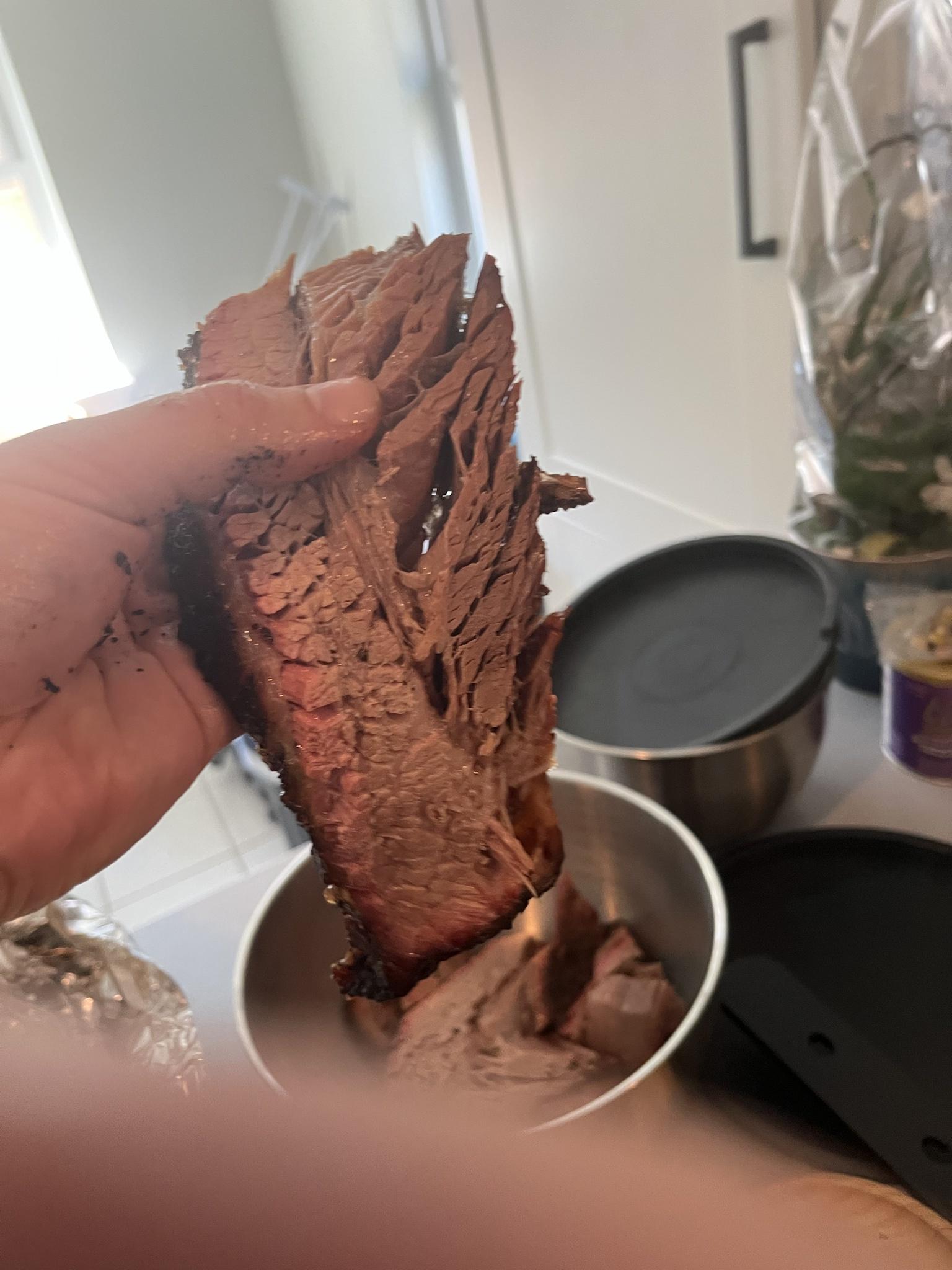
Held up under its own weight, barely.

And look how that big piece passes the bend test. Overall, this is my favorite brisket I’ve ever had let alone made. Growing up I always hated brisket cause I thought it was dry and tough and why would you waste a day on it. I can spend literally 15 minutes cooking a steak that tastes 15 times as good. Like overcooked broccoli, I’d never had good brisket until adulthood. I’ll definitely keep making it and hopefully get as good results. After this one, I think brisket really isn’t as hard as a lot of people make it out to be; you just need to have a good understanding of what your cooking and what turns it out well (like anything one cooks…). Point is, it’s not some near magical thing that some make it out to be. Key takeaways are 1.) keep as level of a temp on the grill as you can whether you are cooking hot and fast (250 to 325) or low and slow (200 to 250) so cook it to the strengths of your grill 2.) foil boat not only decreases cook time but also braises the meat keeping it moist while still allowing bark to develop on top 3.) separate (cut) point and flat. Yes you can turn out a great brisket without doing it, but it’s a lot harder and no one is going to know when it’s sliced up on their plate. In this cook, there was a six hour difference in when flat and point were done. Point literally took twice as long as the flat so if they were together I would’ve had three options, all of which I have turned out before ; good flat with tough point, overcooked flat with tender point, shitty brisket that is barely ok no matter what part you are eating which is apparently what I grew up on te4.) a long rest makes a big difference. I’ve heard people say, don’t use the warmer function in your oven, but that’s the closest I can get to the Franklin BBQ method without robbing a kfc (it’s rumored he bought fried chicken warmers to keep his briskets wrapped at 140f overnight before he opens the next morning) and it worked great for me 5.) internal temp is more important than anything else. Subsection a.) Meat only takes on smoke up to about 160, so after that it’s only about controlling heat not smoke (at this point you can switch the meat to your oven). Harry Soo says “btu is btu”, meaning if the meat is above temp to take on smoke, it doesn’t matter where the heat is coming from. Subsection b.) All the stuff, connective tissue, that makes meat tough, renders above 180f, so keeping your meat in that 180 to 205 range (brisket, pork butt, ribs, really any bbq meat, or tough cut fatty meat) until tender is key, which is why the long rest is important, just getting the meat up to 205 and then cooling immediately, whether by slicing it up or setting it on a cutting board directly off the grill to cool, does not give all that connective tissue time to render, so you really want to keep it in that range for several hours, either by temp regulation or a warmer. The two people I would say to follow if you are getting into bbq (especially if you do kamado) are SmokingDadBBQ and ChudsBBQ on YouTube. Smoking dad almost exclusively does kamado and I learned most of my basics and tricks like double indirect cooking from him. Chudds just really has some great ideas and while he doesn’t cook on a kamado just offers some great insights into not just bbq but cooking in general. Also, I made his pickles for this cook (like a pound of cucumbers) and those were gone with only serving like 8 people.
UnitConversionBot
800f ≈ 430 ° Celsius or 700 Kelvin
UnitConversionBot
300f ≈ 150 ° Celsius or 420 Kelvin
UnitConversionBot
250f ≈ 121 ° Celsius or 394 Kelvin
ChromaticPassingTone
Looks delicious. That bend pretty much answers the question about pull test. Awesome work, op.
smax410
Thank you!
AtleastIvegotthatgoingforme0
What is your address?
smax410
Texas. Not worth coming to for the bbq even this good. You can make good bbq anywhere. You do not need to come here for it.
ChromaticPassingTone
Texas here too. Hence I can fully appreciate what goes into a quality brisket.