
jjw9

2880

35

3
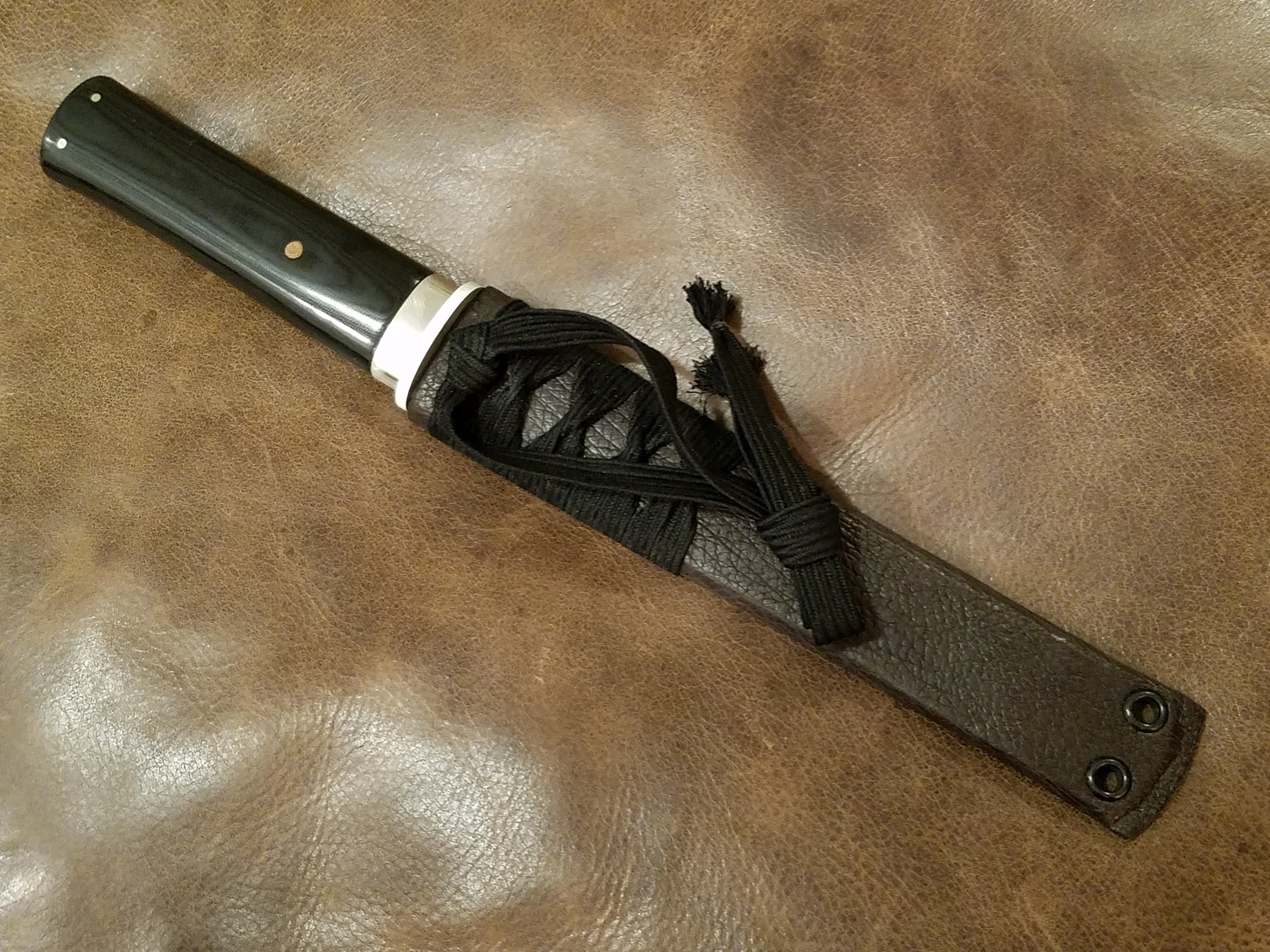
Here’s a beautiful, take-down knife rendered on a Japanese Tanto design, and which is a fusion of modern and classic features and materials.
One of the great attributes of the Japanese Nihonto designs are how they come apart into the discrete components, for user maintenance, without the use of special tools. More on that later.
The handle is carved from canvas micarta, which is essentially a canvas material impregnated with epoxy, and which cures to form a reinforced material that has great resilience, weather resistance, and durability. Note the grain of the canvas micarta, which when exposed across / through the layers of the canvas material gives a pattern like wood grain.
The sheath is made from ray skin stretched over metal and lined with heavy felt. This is a sheath style pioneered by the late Bill Moran. This particular ray skin is amazingly soft like fine glove leather, with a remarkable, naturally crenulated texture. The wool felt lining gives excellent retention while polishing the blade on each pass, as the blade is removed from and re-inserted into the sheath.

Here it is unsheathed.
The blade has been hand-polished in the traditional method developed by the Japanese, for their Nihonto, over many centuries. Though it is actually a satin finish with a “brushed” texture going lengthwise along the blade, the strokes are micro-polished and louvered so that anything 45 degrees to the blade grind becomes reflected as if the blade were a mirror polish.
Note the minimalist (simple, lightweight) design of the sheath.

Here is the right side perspective of the blade.
This view shows how the appearance of the blade finish transitions from satin to mirror depending on the angles of the grinds, which influence the angles of incidence (when speaking to the physics of optics).
Though the sheath looks like it can take the blade from either orientation (i.e. edge up or edge down), it is designed to accept the blade from only one direction as the interior is contoured specially to the profiles of the blade.
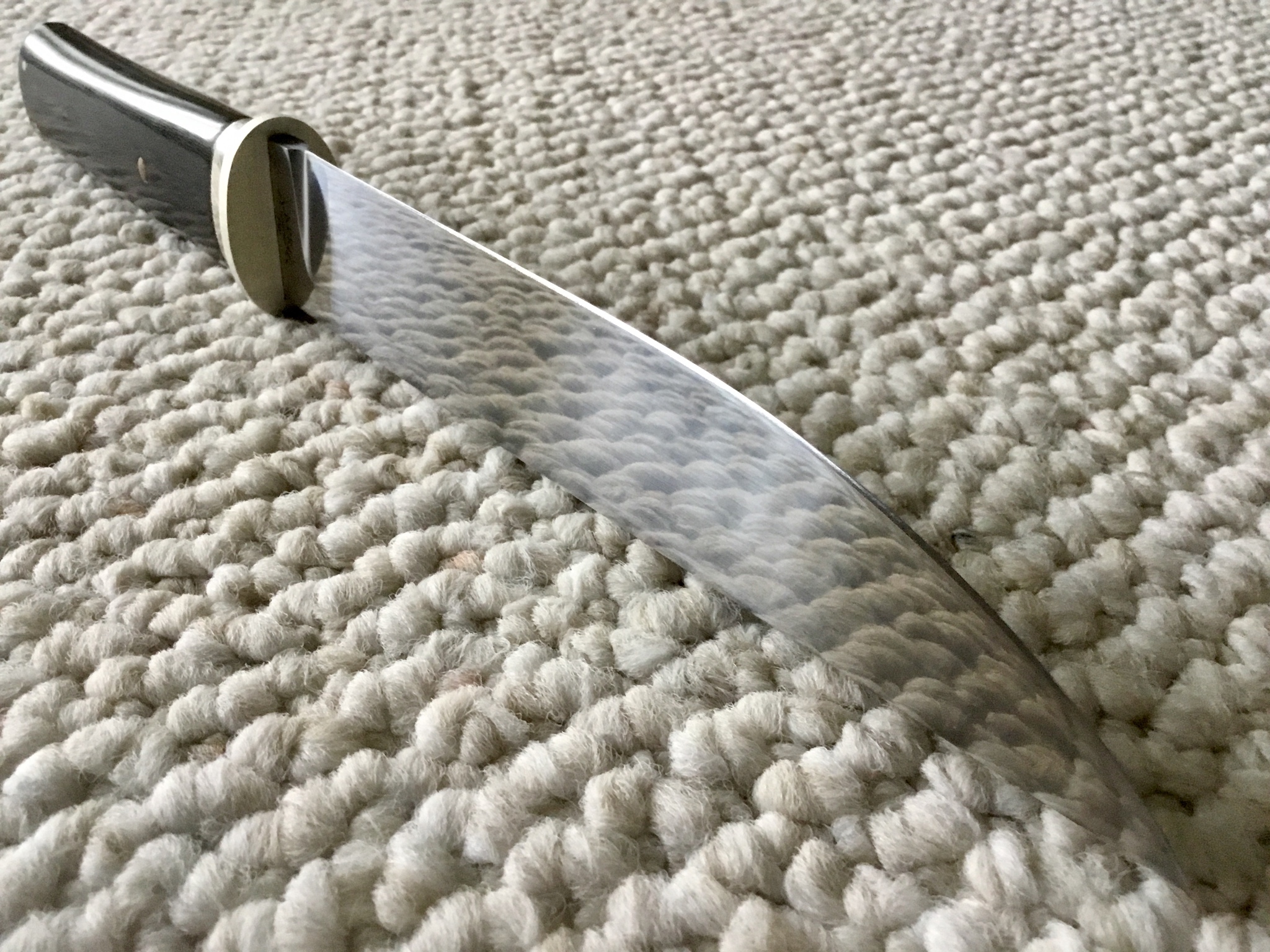
Here’s a blade-up perspective.
I call this finish a “ghost” finish as from many angles, the blade seems to disappear into its surroundings via “reflective camouflage.”
Since the structure of the finish is actually highly fractal, composed of many, microscopic, mirrored bevels in precise alignments, the optical effects give what appears as a surface mapping (mirage) of the surroundings onto the blade while allowing optical overlay of ambient light to “shadow” the actual contours of the blade.

Here you can see the satin finished Tanto with a mirror finished, push dagger.
Note how the bevels on the Tanto seem to be mirror polished when they are, in fact, not.

Here you can see the Tanto disassembled into its component parts. The take-down requires no special tools, and when fully assembled the fit between the components are so precise that there is no wiggle or play.
From this view, you can see better the actual, satin polish of the blade.
I’ve labeled the component parts with their traditional Japanese nomenclature.
The blade is a stylization of the traditional Tanto design, as mentioned earlier. Note how instead of the traditional habaki (blade collar that goes above the guard) there is instead a ricasso.

The blade is differentially hardened via heat treatment using clay tempering.
Clay tempering is where a clay slurry is applied over most of the blade but leaving the edge exposed. The blade is then heated to a higher critical temperature and then quickly quenched in oil. This transforms the steel at a molecular level to give a hardened edge, and a more malleable and flexible spine. The process leaves a visual border, called the “hamon” in Japanese, where the hard steel transitions to the softer steel.
Oh yeah — that massive bump on my forearm is not my elbow but the profile of a large vein. I was particularly “ripped” (lean, with exceptionally low body fat) at the time this photo was taken. :)

Here’s more of the “ghost” finish, with the blade up and the details of the ricasso profile showing.

Angle away the ambient light and the blade melts into its surroundings!
neithere
I really hope Polish/Finish is a conscious play on words.
jjw9
:) ????????
tonyjarrets
Woah...you won’t be needing the blade with an arm like that.
jjw9
Thanks for appreciating my arm! :)
slapyamomma
Tanto with the sharp/strong geometric edge is my favorite
jjw9
Tanto here is traditional. Geo edge is a Westernized variant. Ok tho, I have something for everyone:
Korbendallas71
Beautiful craftsmanship. Looks stunning and lethal.
jjw9
Thank you for your good words, Korbendalls71!
madguillotine
Wow! Sexy, sexy blades!
jjw9
Thank for appreciating, madguillotine! I like your sharp Imgur handle!
madguillotine
Thanks. Madame Guillotine was my 1st Skyrim character. I liked it but didn't want to be obvious about being a chick. I shortened it to Mad.
jjw9
Really outstanding! Thanks for sharing the great history on your handle!
[deleted]
[deleted]
jjw9
I enjoyed reading your post (at your link) and upvoted it! :)