
SgtLemming

1495

16

1

Right side of the trolley.
This is Box'o'Bangs. A 2.2KJ 2500V 640µF capacitor bank. Sometimes also called an "impulse generator"
Basically it creates very high power pulses of high voltage electricity... we use it to make things disappear.

Back end of the trolley showing the primary discharge resistors.

Left side of the trolley.

Front of the trolley showing the inputs and voltage controls.

Closer show of the IO panel, the connector top left goes to the hand control, Variac sets the input voltage to the high voltage transformer, normally set to 170V output so we don't overvolt the caps.

The hand controls, these are attached using a standard Cat5 cable to the bank, but without this attached, you cannot enable any of the systems on the bank.
This allows me (or whoever is controlling it) to stand back and run the "show" from a safe distance.

Output terminals on the top of the trolley. These are 1" brass bars. should be good for a few amps!

Good old RJ45 connector for connecting the and control to the bank. Original plan was to have these on both ends, but due to a miscommunication I only ended up with one of them and funds being a bit tight I've not been able to afford the second one yet.

Close up of one of the resistors on the "Crowbar" bank. These resistors are permanently tied to the cap bank and as such will always be dissipating power when the bank is charged/charging. Hence the nice big heatsink!
It's a little overkill... but the price was right! FFFRRREEEE! :-D

The "Crowbar" resistor bank. Also known as the tertiary discharge resistor. It also functions as a voltage divider to give us a much simpler to measure 250V reference on the DC side.
Accurately measuring 2500VDC that can happily provide thousands of amps becomes... tricky.

The "Crowbar" resistor bank.

The "Crowbar" resistor bank and it's cooling fans, again they're complete overkill, but I had them spare and they look the part.
They're actually some old AMD stock heatsink fans. ^_^

The "Crowbar" resistor bank and it's cooling fans

More Crowbar.

One last shot. Red is HV input, green is metering and then 0V comes off the other end (not pictured here)

The hand controller, I tried to design this so it was not possible to do something silly like control it with one hand while touching one of the outputs or something.
You have to hold the charge switch forward the entire time, because as soon as you let it go the voltage starts going down again.

The air switch wired to the cap bank, and the wonderful stars of the show themselves.

Closeup of some of the wiring.
Ultimately I'd actually like to replace all this wire with a couple of nice big copper sheets. Unfortunately that's well outside the budget atm.

Below the plastic insulator is the ground or 0V wiring, above the plate is the high voltage wiring.

Connections through the trolley surface to the output terminals, The black wire leads off to the primary discharge resistors which are actually in parallel with the output terminals.
This way if whatever we're trying to make go boom doesn't conduct for some reason, the bank will discharge through these resistors instead.

Safety and control circuitry, this was all built with the assistance of a friend of mine who is as keen to see this running as I am. As you can probably tell we've put a lot of effort and thought into the various control systems for this thing.

Earlier version of the above, it evolved quite a bit.

The new and rather epic can launching coil. When you put 2500V at OMG amps through a coil of a nice conductive material it creates quite the magnetic pulse.

Previous experiments with the old bank had us getting empty cans to ~85Km/h (~54Mph). I'm hoping with the other upgrades and this beast to get them over 100.

This coil is going to get potted in silicone so that we don't get any "flash over" or other such fun things.

My beautiful output terminals. These are pieces of 1" round brass bar that have been machined. There's an M10 thread in the top of each one to bolt things into place, and they're bolted in with the same size in the bottom.

Closeup of an earlier version of the above. Only real change is the new ones are a bit higher... and cleaner.

Another closeup view.

Prototype of the input panel, I had an Arduino mounted behind this one for metering and control... but started to realise that may not be the best idea in this kind of "adverse" electrical environment.

Ever older version of the IO panel.

HV relays. Gotta love Ebay sometimes, I found these two little HV reed relays on Ebay for a whole $16 or something like that. Allowed me to add one more layer of isolation to the mix.

The air switch. When you're dealing with this sort of voltage and current it get's a little trick trying to find something that can actually switch it for you without becoming an inadvertent test subject itself.
I've tried quite a bit to find some silicon that might come close, but there's not much available, let alone readily available on this side of the pond.

More air switch. The pin through the lower contact is to prevent it changing position inadvertently.
The upper contact is attached to a pneumatic ram which fires it out quite rapidly and brings it within the desired 1mm of the stationary one. The stationary contact is threaded to allow adjustment of the gap as the surfaces wear over time.

More Air switch.

Closeup of the moving contact and it's guide block. The white material is HDPE which is reasonably ideal for this purpose being a good insulator.

Closeup of the gap in the switch, because of the rather insane amount of energy involved, I'm not actually going to let the switch contacts touch. If they did they would likely weld together... instantly.
With 2500V across the contacts, all I have to do is get them to within about a mm of each other and the voltage will actually jump over and do the rest for me! I lose a little bit of energy this way, but it saves replacing the switch after every shot!

Machining the pieces for the air switch.
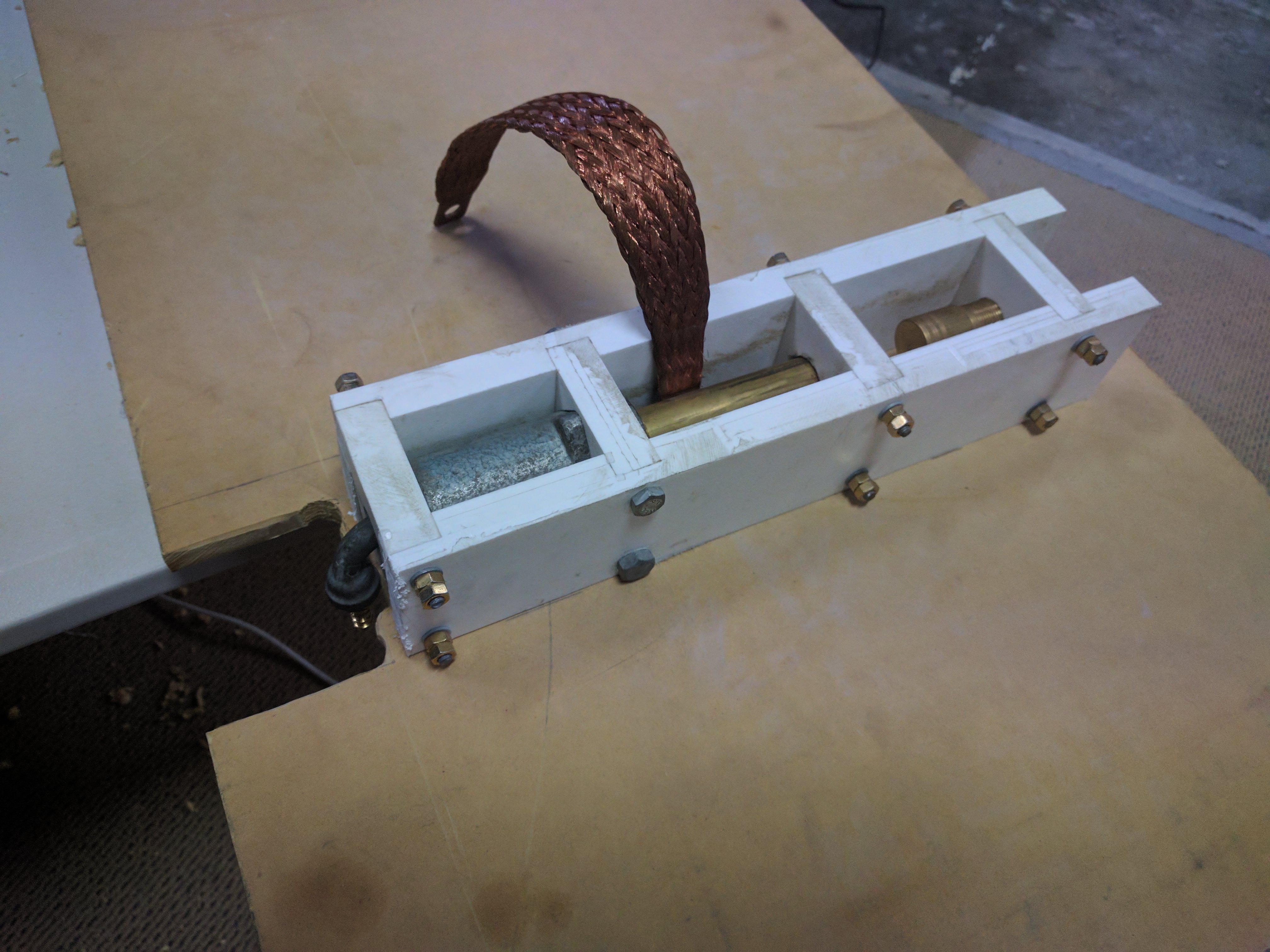
Air switch mounted to the cap tray.

Primary discharge resistor. This is actually a pair of 1KW heating elements out of a HVAC system that was being replaced. They're 60 ohms each but with the 2 in series that gives me 120 ohms total.

Not originally rated for 2500V usage but I've tested them on a 6KV NST and got no leakage on the outer metal shell or fins.

Original very dodgy wiring for testing.

Nice beefy cooling fan for getting rid of any heat we do happen to generate.
aDENTinTIME
tl;dr Looks like OP put a lot of work into this, hope it's not a bomb, here
mbo2o
Need a video of it operating
UnicornFartCollector
Looks scary